QR code
Scanned from a van, shelf ticket, flyer or screen. The conversation opens with that code's source and campaign tags attached.
Understand where customers came from, what they asked, what they wanted and what happened next across websites, forms, social media, television, streaming, QR codes on products and displays, signage, vehicles and more.
More customers from every touchpoint. More intelligence from every interaction.
 Instant InquiriesCustomer intelligence
Illustrative signal map
Traditional analytics is good at counting actions. Someone clicked, visited, scanned, submitted or left. But a count rarely explains why.
What were they looking for? Which product interested them? Was price stopping them? Were they ready to buy? What did people ask before they became a lead? What did the people who left need?
Instant Inquiries adds the missing conversational layer, connecting the source of an interaction with what the customer actually wanted.
Whether digital, physical, spoken or submitted, each interaction can arrive with its own context and become part of the same analysable customer story.
Illustrative conversation record
Every campaign or touchpoint can carry attribution data. Digital interactions can include source, medium, campaign, content, keyword, referring site and advertising click information.
For physical assets, give each one its own source tag, such as van_03, and keep the promotion in the campaign tag. The asset stays identifiable across promotions without losing campaign context.
Illustrative. Tags are set when you create the QR code.
Some customers scan a QR code. Some tap through from a social media post. Then some speak, some type, and some complete the form you already have. Each path can preserve its own detail while contributing to the same intelligence layer.
Scanned from a van, shelf ticket, flyer or screen. The conversation opens with that code's source and campaign tags attached.
From a post, ad or profile link, including inside the Facebook, Instagram and TikTok apps. The platform and campaign stay with the conversation.
Natural questions, captured while interest is fresh.
A lower-pressure way to ask, explore and enquire.
Keep the forms you already have. Submissions are captured with where the visitor came from, can go to SMS, email or a webhook, and can be included in your analysis feeds.
A television or streaming campaign can reach thousands of people in a few minutes. A vehicle can travel for a year. A retail display can sit across 30 stores. A product can remain on a shelf through several promotions. Instant Inquiries can help connect those moments with real customer questions and intent.
A QR code on a product, package, shelf ticket, counter card, end-cap or showroom bay can carry tags for the store, display, product and promotion that started the conversation.
That creates a direct conversational research channel while the customer is considering the purchase, not weeks later in a survey.
“Does this model work with natural gas, and is installation available?”
Product interestX200 outdoor kitchen
Purchase considerationCompatibility + installation
Location signalMarion · End-cap 4
OpportunityClarify compatibility on display
Aggregated Intelligence is the combined view created when attributed conversations from different channels are analysed together. It goes beyond collecting more metrics. It reveals the questions, needs and objections that repeat across channels, and the signals that only appear in one.
Social media can show the message that started interest. Television can identify the campaign, creative or broadcast window. A product on a shelf can identify the exact item and location. Together, they create a more complete picture of customer demand.
Connect the platform, post, advertisement, creator, campaign and landing path with the questions people ask next.
Use a campaign QR, short path or identifiable response route to connect a conversation with the channel, program, creative, region or time window.
Tag the store, display, product and promotion while the customer is actively comparing options.
Installation, compatibility and delivery timing are recurring across paid social, television responses and in-store product conversations.
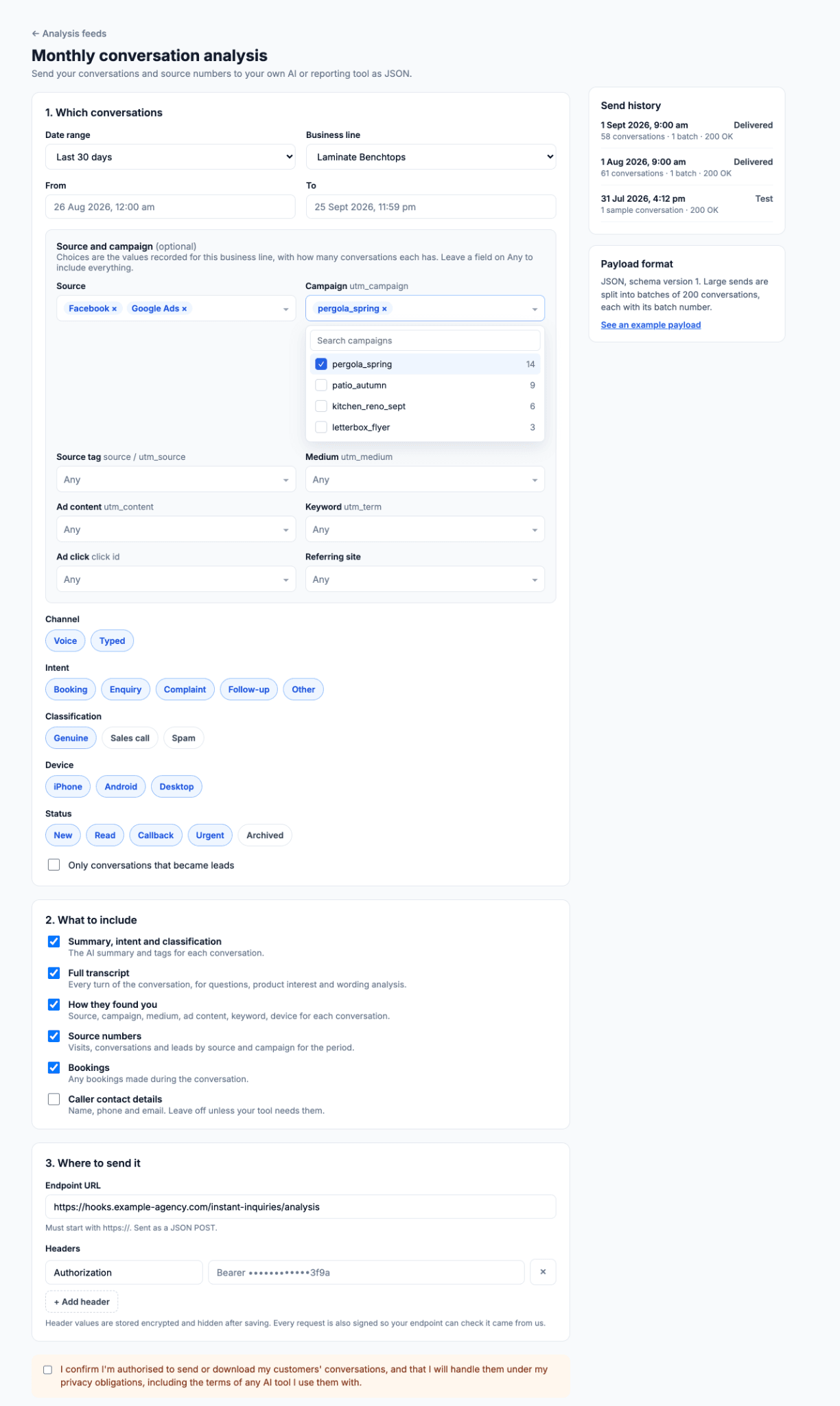
Filter the conversations that matter, choose the data to include, and send a scheduled structured feed to an authorised AI, reporting, automation or analytics endpoint.

Traditional analytics needs the event or field to be defined in advance. A retained conversation can be analysed later from a completely different perspective.
That means a business can return to historical conversations and investigate a new product question, competitor mention, emerging objection or campaign change that nobody thought to track at the time.
Search created the highest proportion of booking-intent conversations. Paid social produced more research questions, television responses showed stronger brand recall, and product-shelf conversations concentrated on compatibility and availability.
This example is illustrative. Your analysis depends on your retained data, filters and connected outcomes.Customers are showing stronger interest in installation timing, while price-related questions shifted toward finance and staged-payment options.
Strongest intentGoogle Ads · booking enquiries
Rising questionInstallation before summer
Content gapFinance options not clearly answered
Recommended actionAdd finance and lead-time answers to campaign pages
Illustrative report format, not customer results.
Scheduled analysis can turn hundreds of individual interactions into a focused briefing for the people who need to act.
Marketing can compare audience quality. Sales can see recurring objections. Product teams can spot unmet needs. Leaders can see what changed and what deserves attention now.
Explore how the same conversational intelligence can answer different parts of the business.
Compare what customers ask after arriving from search, social media, television, streaming, email, print, signage, product shelves or QR. See which sources produce genuine enquiries, which create research questions and where the message does not match the customer's need.
Each feed can be shaped around its purpose. Select the conversations, include only the fields the receiving system needs, and keep contact details out unless there is a clear authorised reason to send them.
Endpoint credentials are designed to be hidden after saving, and feed delivery can be signed so the destination can verify the request came from Instant Inquiries.
Privacy obligations remain specific to the business, its customers, its connected tools and the terms under which those tools process data.
Bring us your website, campaigns and physical touchpoints. We will show you how Instant Inquiries can connect the source, the conversation and the intelligence your team can act on.
Clear answers about what this layer can see, how it connects and where the boundaries are.
Ask us something specificIt is the ability to connect where an interaction began with what the customer asked, what they appeared to need and what happened next. Instant Inquiries can bring website conversations, forms, campaigns and attributable physical touchpoints into one analysable layer.
Website analytics usually records behaviour such as visits, clicks and conversions. Instant Inquiries adds the content and context of the customer's interaction: their questions, intent, objections, product interest and enquiry outcome.
No. Those tools remain useful for reach, traffic and campaign performance. Instant Inquiries adds a conversational layer that helps explain what people actually wanted after they arrived, clicked or scanned.
Yes. The widget script captures submissions from your existing lead forms without changing the form. They can go to SMS, email or a webhook, and scheduled analysis feeds can include them alongside voice and typed conversations, with the campaign and source that brought the visitor.
Each QR code can carry its own tags: a source for the asset, such as a specific van or store display, plus campaign, medium and content for the promotion running at the time. The asset and the campaign can then be analysed separately.
Where each interaction carries suitable attribution, you can compare the questions, intent and outcomes generated by sources such as Google Ads, Facebook, email, website traffic, vehicle QR codes, retail displays, signage, print or television.
Paid and organic social activity can carry platform, campaign, advertisement, post, creative, creator or landing-path context into the next attributed interaction. Instant Inquiries can then help compare what those audiences asked, the intent they showed and whether the conversation became an enquiry. The available attribution depends on the platform, link structure and connection in place.
Yes, when the campaign gives viewers an identifiable response path such as a dedicated QR code, short URL or campaign destination. The resulting conversations can be associated with details such as campaign, creative, channel, region or broadcast window, then analysed for the questions and intent that appeared after viewing.
A product, package or shelf ticket can carry tags for the store, display, product and promotion. That lets customers ask questions while comparing the item and gives the business direct evidence about compatibility concerns, missing information, objections and purchase intent at the point of choice.
Aggregated Intelligence is the combined analysis of attributed customer conversations across multiple touchpoints. Instead of viewing social, television, website, retail and physical media as separate reports, it reveals the themes that repeat across them, the differences between audiences and the actions suggested by the complete dataset.
Not today. Instant Inquiries records leads and bookings made in the conversation. It does not see POS or ecommerce sales, and does not guess them.
Depending on the configuration, a feed can include conversation summaries, intent and classification, full transcripts, attribution details, source totals, bookings, website form submissions and contact details. The business chooses what is necessary for the purpose.
Feeds can be delivered as structured JSON to an authorised endpoint, such as an AI analysis service, reporting system, automation platform, agency workflow or other compatible destination.
Potentially, yes, provided the relevant data was retained appropriately and the analysis is authorised. Because the conversation contains natural language, it can be revisited for themes that were not defined as fields at the time.
Feed controls let the authorised user filter the conversation set and choose which fields to include. Sensitive information such as contact details can be excluded when it is not needed. Each business remains responsible for its privacy obligations and connected tools.
No. Instant Inquiries is designed to work with the customer journey and processes already in place. The exact connection depends on the website and systems involved, which can be assessed during setup.
It is valuable for service businesses, retailers, manufacturers, multi-location organisations and agencies that need to understand customer intent across several channels, especially when physical touchpoints have previously been hard to measure.
Book a demonstration and bring a few real examples, such as a website journey, campaign, form, QR placement, vehicle or store display. We can map how attribution, conversation and analysis could work for your situation.